UPDATE ALERT
2017
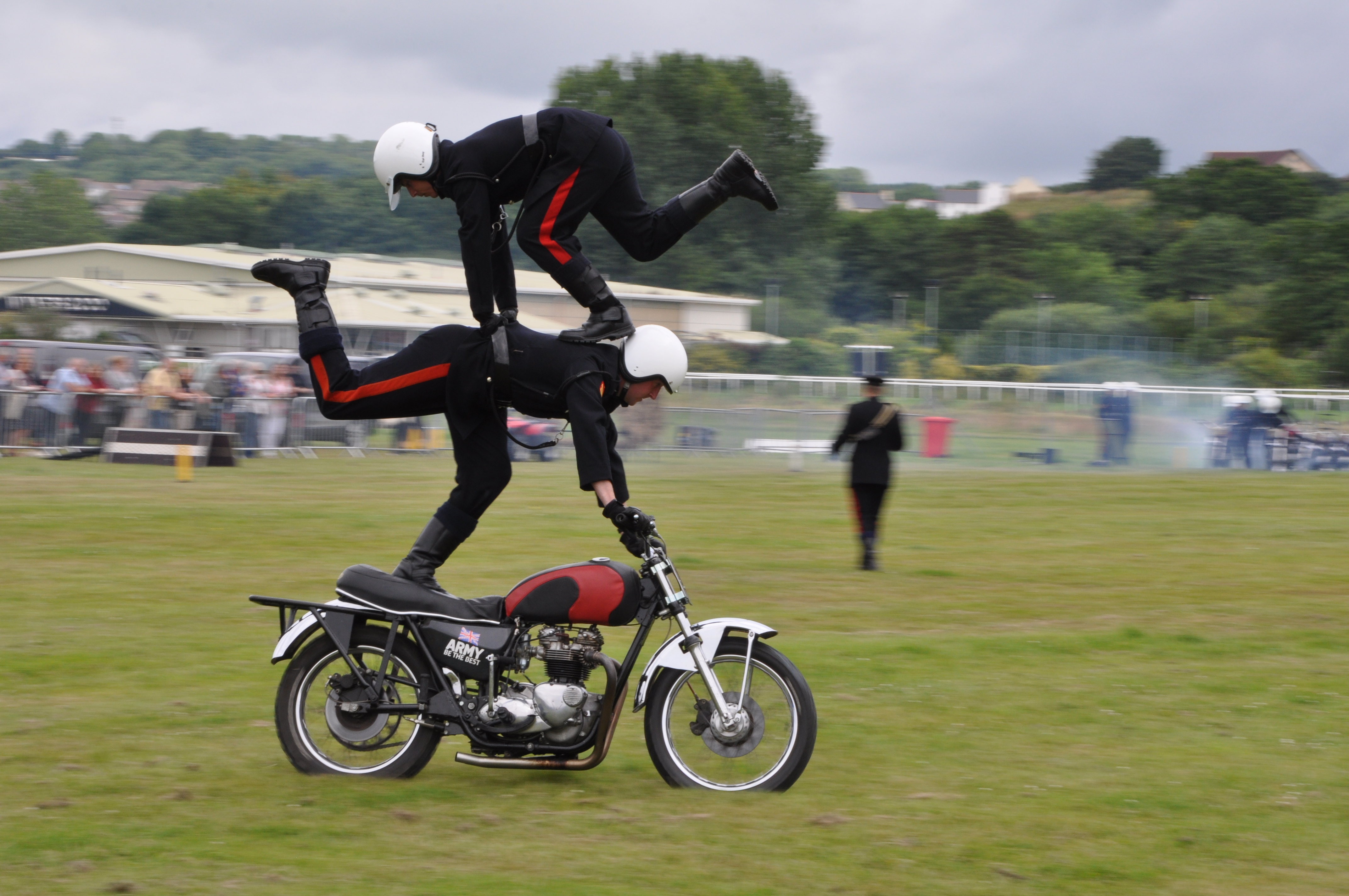
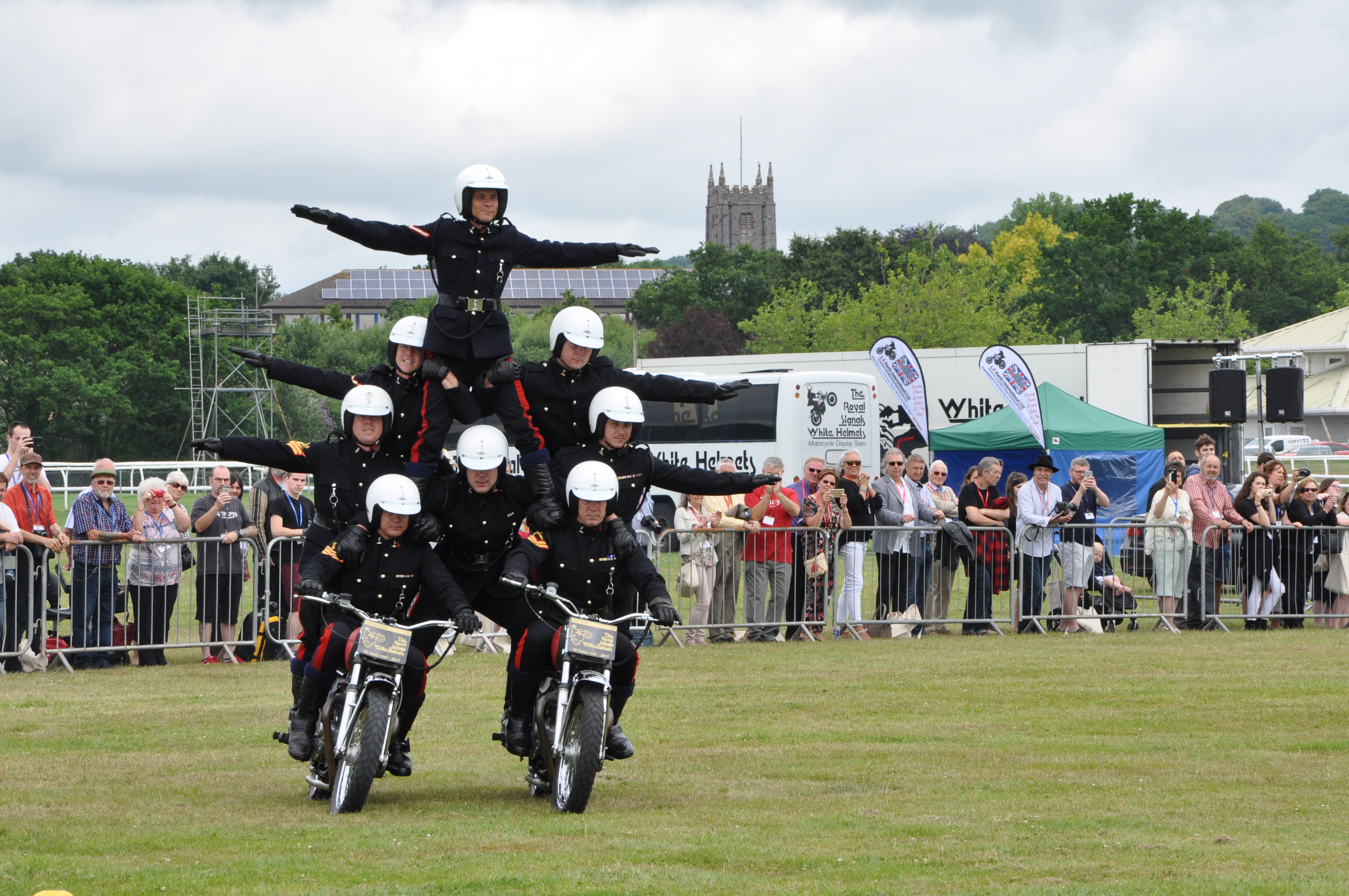
September ’17 sadly sees the final performance by the magnificent White Helmets Motorcycle Display Team. The highly skilled riders from the Royal Corps of Signals have thrilled crowds for ninety years with death defying feats on their Triumph motorcycles. The machine of choice for many decades now has been the Triumph Tiger 750 – a proper British motorcycle of course, first developed at the Meriden factory in the early 70s. The White Helmets’ machines are modified to enable them to perform fantastic stunts like the Forward Ladder, The Tableau, The amazing jump through a Ring of Fire, and the extraordinary Six Bike Fan Pyramid.
Thanks to Oliver Barnes of Tri-Supply, a supplier of high quality spare parts for classic Triumphs and L.F. Harris (International) Ltd, who have sponsored the White Helmets for 34 years, I was privileged to be at a special performance at Newton Abbot Race Course in July 2017. As the show field came alive with the sound of snarling Triumphs, soon to crescendo into a spine tingling roar, the memories came flooding back. Coming from a military family I used to enjoy The Royal Tournament and The Aldershot Army Display shows at Rushmoor Arena and the best bit was definitely the immaculately turned out White Helmets.
Watching them in Devon this summer was a privilege and it is frankly outrageous that the MOD has pathetically deemed the White Helmets show to be ‘out of date’. It is clear to see that much of British Army ceremonial has nothing to do with today’s professional army. However, the White Helmets’ display has everything to do with strength, discipline, courage and trust, all qualities that appear to be sadly lacking in the modern world. Surely, it can only ever be a positive thing to continue such demonstrations of precision and control that have thrilled and inspired crowds since 1927. Of course, I am not surprised at the so-called progressive attitude of the twenty-first century MOD. It was always only a matter of time before the nation hating mentality of the establishment, who seem hell bent on erasing our history, would seep into the domain of the armed forces. I had hoped and naively believed that this would be the one area which would put up some resistance. How wrong I was!
So the White Helmets will be gone – but never forgotten. From now on when I venture out on my own Triumph Tiger 750, the snarl will be that little bit crisper, the roar will be that little bit louder and I will hit those bends that little bit faster – all in deference to the peerless White Helmets.
September 2015
I was sad to hear of the recent passing of Lord Montagu of Beaulieu. I was fortunate enough to have met Lord Montagu on several occasions, most notably in chilly November 2003 when I sat beside him in his Daimler on the London – Brighton run while filming a documentary. It never stopped raining all day, His Lordship was understandably keen to ‘press on’ and it was down to me to make sure his hat didn’t fly off! He was a great character who championed the preservation of motoring history and everyone who has any interest at all in the world of old vehicles has a heck of a lot to thank him for.
January 2015

I gave my ‘First 100 Machines’ talk at a National Motor Museum Friends’ Evening on Saturday 17th January. Of course, I only managed to cover about 40 machines in two hours but that appears to be the norm with this presentation!
It was great fun to share my tales and thoughts about machines I have encountered over the years and am glad that the presentation seemed to be appreciated by attending Friends. Most of my recent trips to the Museum have been for filming or presentation reasons and while seeking a suitable photo location, it occurred to me that I really must take more time on my next visit to actually have a good look at the exhibits themselves. I have promised myself that I will do this in the very early spring!
October 2014
I recently participated in the 20th anniversary celebrations of the Mazda MX-5 Owners Club. In a sense the Mazda MX-5 was conceived as a spiritual replacement for the classic British sports car after our industry was destroyed and abandoned. The original MX-5 is probably most akin conceptually to the Lotus Elan and was the first of three phases of the model from 1989 to date. The Owners Club now boasts a membership of 6000 and on the 25th anniversary of the car itself, no less then 1500 examples arrived at Gaydon to join the celebrations. I enjoyed a delightful day and was made to feel very welcome by one of the friendliest car clubs I have encountered.
I was offered a short drive in a Mark I car and Mazda kindly lent me a 2014 (Mark III) car for the weekend so I was able to at least make some sort of comparison. As is so often the case in these situations, my preference is very much for the early car. The current model is a fantastic machine with an amazing retractable roof mechanism and is not only great fun on the twisty stuff but is a very capable motorway car as well. However the earlier car is also a strong all-rounder and its clean lines, relative simplicity and uncluttered interior won the day for me.
______
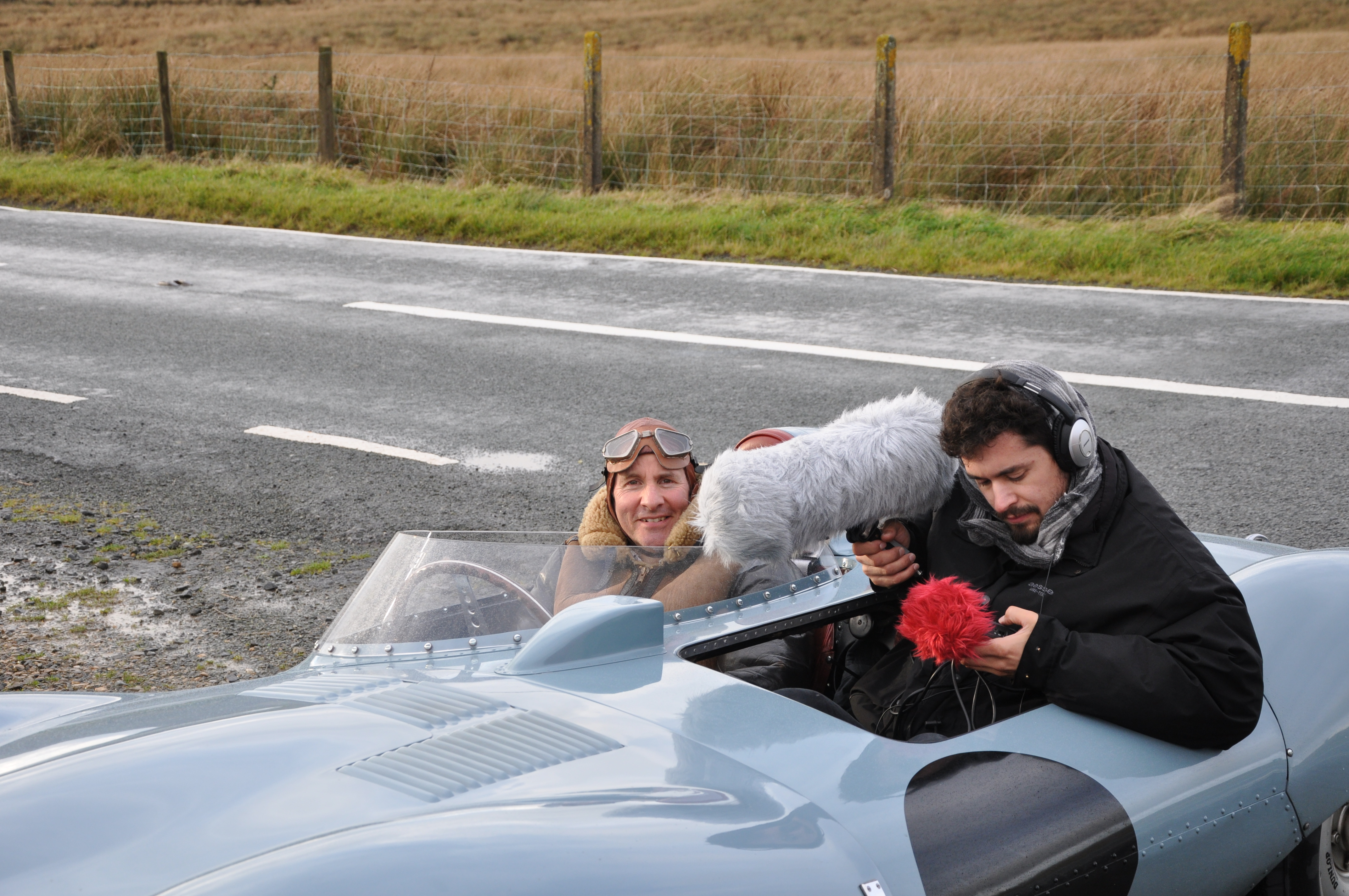
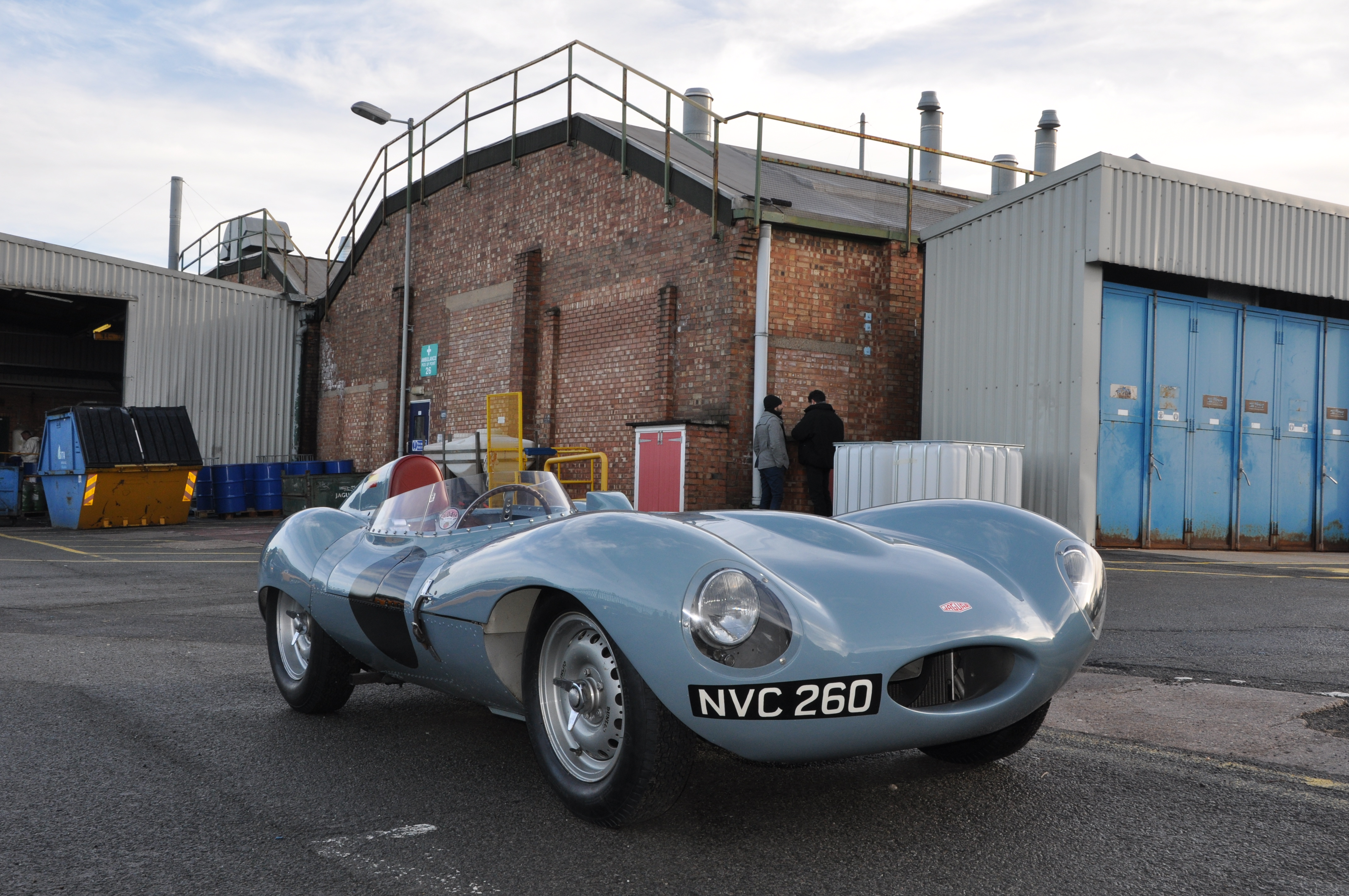 In November 2013 I was fortunate enough to be asked by Simon Kidston to take part in one of his short films. The main stars of the film were a D-Type Jaguar and the legendary former Jaguar test engineer Norman Dewis. Once I had picked myself up off the floor and fully recovered from this mind blowing invitation, I prepared myself for what turned out to be two of the most exciting days of my life. I won’t say anymore now but would simply ask you to follow the link below and hope you enjoy watching ‘D-Day’ as much as I did making it!
http://www.kidston.com/kidston-news-item/167/D-Day
______
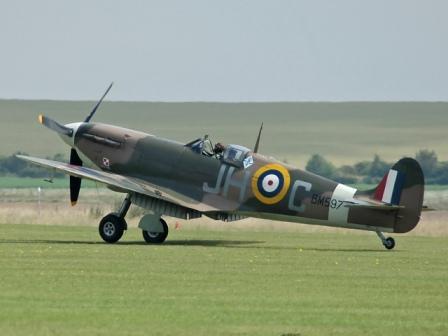 Nothing provides us with a window into the past quite like old machinery and transport. Whether it is a Supermarine Spitfire or a BSA Bantam, any old machine invites you to immerse yourself in a bygone era. You can see it, hear it, feel it, smell it, take it apart, rebuild it and in many cases, drive, ride, fly or sail it. As every second elapses you are not only reliving the experiences of previous generations, but you are developing a relationship and learning to cope with the moods of a piece of engineering that is, to all intents and purposes, a living thing.
 In an increasingly bland, digital age where everything is ‘i’ this and ‘auto’ that, or do this ‘by wire’ and ‘voice activate’ that, we no longer have such a physical involvement with technology. Also, ridiculously far reaching health and safety regulations discourage us from handling any kind of modern machinery unless you have the 47 certificates to prove that you’ve ‘done the course’.
I believe that old analogue equipment is good for us as human beings. You only have to look at the relatively ‘hands off’ mentality of today’s society compared to the ‘can do’ generations of yesteryear. Today if the lawnmower breaks down, many would immediately ‘google’ a DIY ‘superstore’ and simply buy a new one with a credit card. I can just about remember the days when, if the old Suffolk Punch futted out, it was dragged into the shed and lifted onto the bench for serious investigation. On went the kettle, out came handbook and wooden crate of well worn tools and dad set about mending the thing. Whiffs of St Bruno from his pipe competed with the ever present pot pourri of 3 in 1, creosote, freshly mown grass and petrol (!), then after some forty minutes of competent if not expert spannering the mower was cheerfully rolled out of the shed. Three pulls later, dad was rewarded by the little Suffolk motor parping into life and settling down to a steady and familiar beat.
Fundamentally, this site is my contribution to the preservation and continued use of our engineering and transport heritage and to encourage more people, especially the young, to involve themselves in this exciting and fulfilling area of life.
While I can appreciate the efficiency of German and Japanese engineering, while I can find some endearing qualities in a smattering of French vehicles, while I can marvel at the style and élan of some Italian exotica and appreciate the brutish, long-legged muscularity of American machinery, I reserve my unconditional love for the products of Great Britain. For me British machinery of the twentieth century represents the zenith of a nation which started the industrial revolution and became the ‘workshop of the world’, exporting all manner of equipment to all corners of the globe, driven on by the talents and genius of men like Geoffrey DeHavilland, Henry Royce, Nigel Gresley, Edward Turner, W. O. Bentley, and Herbert Austin to name but a very few. I look beyond the iron and steel and timber and fabric and see the spirit of a people who contributed to this industrial might and remember them and their forefathers, many of whom gave their lives to defend this amazing archipelago.
Nowadays it almost makes me weep to think that our great engineering and manufacturing base has been swept away in the name of globalisation and the Britain that we once knew and loved has over a few short decades been steadily sold off and virtually abolished. I think we should take the qualities of our amazing industrial and engineering past and use them to help realign our future. Let’s just say that when I am in the presence of a Rolls-Royce Silver Ghost or a Gresley A4 Steam Locomotive I am very much connecting with the soul of the Britain of yesteryear, a proud Britain, a strong Britain, a better Britain.